
CT Scan Centers in Madurai – A Complete Guide to Computed Tomography (CT) Scans
Computed Tomography (CT) scans are among the most commonly used diagnostic imaging procedures in modern medicine. They provide detailed cross-sectional images of the body’s internal structures, helping doctors diagnose injuries, infections, tumors, and various medical conditions quickly and accurately. CT scans are especially valuable in emergency medicine, trauma care, and the evaluation of complex health problems.
If you’re searching for CT Scan Centers in Madurai, this guide explains how CT scans work, their uses, different types of CT examinations, preparation guidelines, and what patients can expect during the procedure. This article is intended for informational purposes and does not promote or recommend any specific diagnostic center.
What is a CT Scan?
A Computed Tomography (CT) scan is an advanced imaging technique that combines X-ray technology with computer processing to create detailed cross-sectional images of bones, organs, blood vessels, and soft tissues.
Compared to conventional X-rays, CT scans provide more detailed images, allowing healthcare professionals to diagnose a wide range of medical conditions with greater precision.
Why is a CT Scan Performed?
Doctors may recommend a CT scan to:
- Diagnose injuries after accidents
- Detect fractures not clearly visible on X-rays
- Evaluate internal bleeding
- Identify tumors
- Diagnose infections
- Assess blood vessels
- Examine internal organs
- Monitor treatment progress
- Guide certain medical procedures
CT scans are widely used because they are fast and provide detailed information in many emergency and non-emergency situations.
Common Types of CT Scans
CT Brain Scan
Used to evaluate:
- Stroke
- Head injuries
- Brain tumors
- Bleeding inside the brain
- Persistent headaches
- Neurological disorders
CT Chest Scan
Helps assess:
- Lung infections
- Lung nodules
- Chest injuries
- Blood vessel abnormalities
- Certain heart-related conditions
CT Abdomen Scan
May be recommended for:
- Abdominal pain
- Liver diseases
- Kidney stones
- Pancreatic disorders
- Intestinal conditions
- Internal injuries
CT Pelvis Scan
Used to examine:
- Urinary bladder
- Reproductive organs
- Pelvic injuries
- Pelvic masses
CT Spine Scan
Helps diagnose:
- Spine fractures
- Degenerative spine disease
- Disc abnormalities
- Spinal injuries
CT Angiography (CTA)
A specialized CT examination used to evaluate blood vessels and identify narrowing, blockages, aneurysms, or other vascular abnormalities.
Medical Conditions Diagnosed Using CT Scans
CT imaging assists in diagnosing:
- Traumatic injuries
- Bone fractures
- Stroke
- Brain hemorrhage
- Lung diseases
- Kidney stones
- Tumors
- Internal bleeding
- Liver diseases
- Pancreatic disorders
- Appendicitis
- Sinus diseases
- Blood vessel disorders
The choice of CT examination depends on the patient’s symptoms and clinical findings.
CT Scan with Contrast
Some CT scans require a contrast agent to improve the visibility of blood vessels, organs, and specific tissues.
Contrast-enhanced CT scans may provide better visualization of:
- Tumors
- Blood vessels
- Inflammatory conditions
- Internal organs
Your healthcare provider will determine whether contrast is necessary based on the reason for the scan.
Preparing for a CT Scan
Preparation depends on the type of CT examination.
Patients may be advised to:
- Wear comfortable clothing
- Remove metallic objects
- Inform the healthcare team about allergies
- Mention any kidney disease
- Inform the doctor if pregnant or planning pregnancy
- Follow fasting instructions if contrast is required
- Carry previous imaging reports for comparison
Always follow the preparation guidelines provided by your healthcare provider or diagnostic facility.
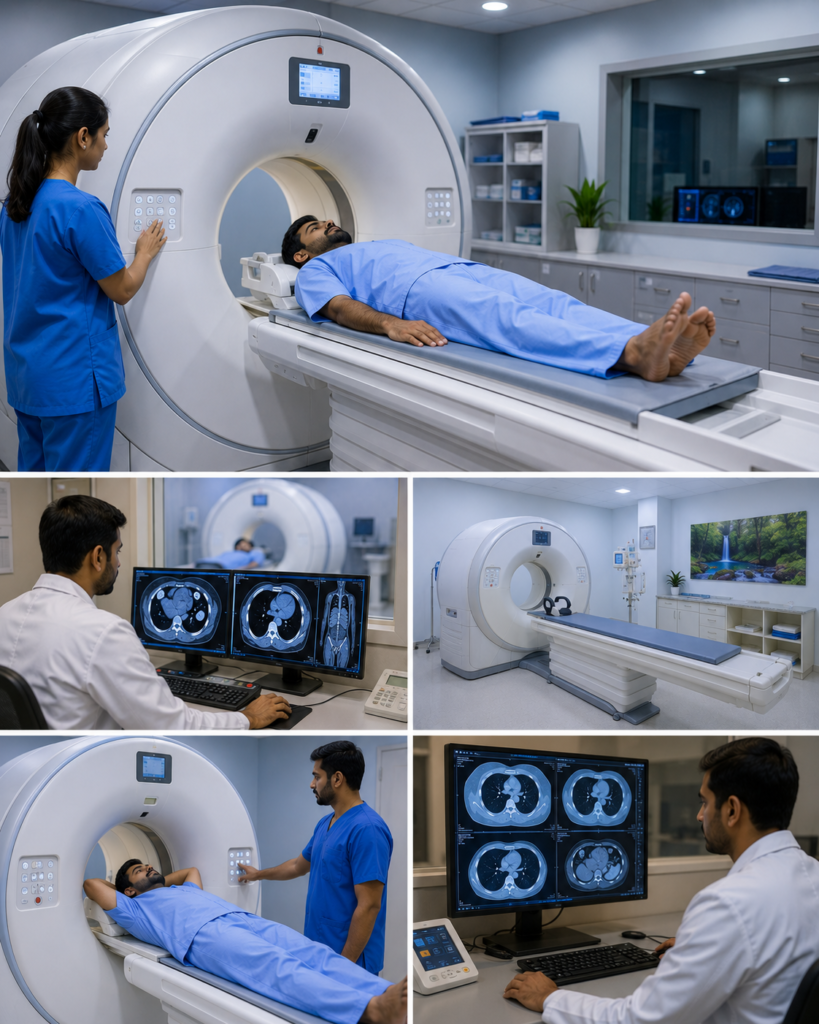
What Happens During the Procedure?
During the CT scan:
- You lie on a motorized examination table.
- The table moves through the CT scanner.
- The scanner captures multiple X-ray images from different angles.
- You may be asked to hold your breath briefly during image acquisition.
- The examination is generally completed within a few minutes, depending on the area being scanned.
Remaining still during the procedure helps produce clearer images.
Benefits of CT Scans
CT imaging offers several advantages:
- Fast examination time
- Detailed cross-sectional images
- Excellent evaluation of bones and internal organs
- Useful in emergency situations
- High diagnostic accuracy
- Helps guide treatment decisions
- Supports surgical planning
- Assists in monitoring disease progression
Are There Any Risks?
CT scans use ionizing radiation, and healthcare professionals recommend them only when the expected diagnostic benefit outweighs the potential risks.
Contrast agents may not be suitable for everyone, particularly individuals with certain kidney conditions or contrast allergies. Your healthcare provider will review your medical history before the examination.
Tips Before Your Appointment
To help ensure a smooth experience:
- Arrive before your scheduled appointment.
- Carry previous medical reports and scans.
- Inform staff about implanted medical devices.
- Mention any allergies or chronic medical conditions.
- Follow all fasting or preparation instructions if provided.
Frequently Asked Questions
How long does a CT scan take?
Most CT scans are completed within 5 to 20 minutes, depending on the body part being examined and whether contrast is used.
Does a CT scan use radiation?
Yes. CT scans use X-rays to create detailed images. Healthcare providers recommend CT imaging only when clinically appropriate.
Is a CT scan painful?
No. The scan itself is painless. If contrast is administered, some patients may experience a temporary warm sensation or metallic taste.
What is the difference between a CT scan and an MRI?
A CT scan uses X-rays and is often preferred for evaluating bones, trauma, and emergencies, while an MRI uses magnetic fields and radio waves to provide detailed images of soft tissues, the brain, joints, and the spine.
Can I eat before a CT scan?
Many CT scans do not require fasting. However, if contrast material is planned, fasting instructions may be provided depending on the examination.
Conclusion
CT scans are an important diagnostic tool that provides fast, accurate, and detailed images of the body’s internal structures. They are widely used to diagnose injuries, infections, tumors, vascular diseases, and many other medical conditions. Whether performed in an emergency or as part of routine medical evaluation, CT imaging helps healthcare professionals make informed decisions and develop appropriate treatment plans. Following preparation instructions and discussing any medical concerns with your healthcare provider can help ensure a safe and effective imaging experience.